

Table of Contents
- Before You Start
- The 7 steps to build a referral program[+]
- Step 1: Set one clear goal
- Step 2: Make sure you’re referral-worthy
- Step 3: Choose the reward, and lean two-sided
- Step 4: Keep the share process to three steps
- Step 5: Pick a tool or platform that matches your size
- Step 6: Track referrals and pay out fast
- Step 7: Promote the program everywhere your customers already are
- Referral program ideas & rewards that work
- What doesn’t work
- Tips
- Warnings
- FAQ[+]
- References
Updated July 2026
If you’re figuring out how to create a referral program that people actually use, the short version is this: pick one clear goal, choose a reward worth sharing (ideally for both sides), keep the ask to three steps, track it with a real tool instead of a spreadsheet you’ll forget, and promote it in the places customers already look. Nail those five pieces and word of mouth starts doing part of your selling for you. It really is that simple to start.
This guide is for small business owners, SaaS founders, freelancers, and e-commerce sellers building their first program, or fixing one that’s gone quiet. It’s one of the more reliable ways to grow an online business without paying for every new customer through ads. Below: the seven steps in order, reward ideas that hold up, what kills programs, and the questions people ask once theirs is already live.
Why bother at all? The pull of a personal recommendation is well documented. A widely-cited 2012 Nielsen study found that around 92% of people trust recommendations from friends and family above any other form of advertising. And a 2011 University of Pennsylvania study of one German bank’s customers found the people who arrived through a referral were roughly 18% more loyal, and worth about 16 to 25 percent more over their lifetime, than customers acquired other ways. Those are two specific studies rather than an iron law, but they point the same direction: referred customers tend to stay longer and spend more.
Before You Start
A referral program amplifies what’s already working. It doesn’t fix a product people are lukewarm about. Before you build anything, get these four things straight.
- A product people already like. If customers wouldn’t recommend you unprompted, fix that first, not the referral mechanics.
- One clear goal. New customer acquisition and repeat purchases from existing customers are different goals with different reward structures. Pick one to optimize for.
- A reward budget per referral. Decide the maximum you’ll pay out per successful referral before you design the reward, not after.
- A way to track who referred whom. Even a basic unique code or link. Without tracking, you can’t pay correctly or measure whether the program works.
Time and difficulty: a manual, spreadsheet-based version can be running this week. A dedicated referral tool or Shopify app usually takes a few days to set up and test properly.
The 7 steps to build a referral program
Step 1: Set one clear goal
Decide upfront which single outcome you’re chasing: new customers, repeat purchases from existing ones, or reviews and testimonials. Each goal changes who you ask and what you reward. A program built to attract new customers rewards the referrer when a friend buys for the first time. A program built for repeat business rewards existing customers for reordering after a nudge. Trying to do all three with one flat reward usually does none of them well.
Step 2: Make sure you’re referral-worthy
Before building anything, run a quick gut check: would your current customers actually recommend you? A one-question survey (“How likely are you to recommend us to a friend, 0 to 10?”) sent to your last 50 or so customers tells you fast. That’s the whole test. Anything short of a decent chunk of enthusiastic answers is a signal to fix the product or service experience first. A referral program on top of a mediocre experience just spreads the disappointment further and faster.
Step 3: Choose the reward, and lean two-sided
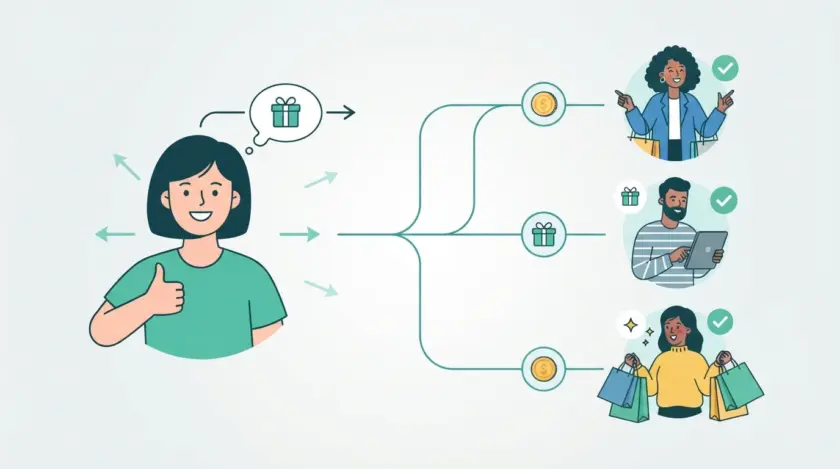
Double-sided rewards, where both the referrer and the new customer get something, outperform one-sided ones for most consumer programs, according to a 2026 industry roundup from Extole. The logic holds up in practice too: a referrer feels awkward pushing a friend toward a purchase that only benefits the referrer. Giving the friend a discount too removes that awkwardness and gives them a reason to actually click the link. See the reward comparison table below for the tradeoffs between cash, discounts, tiers, and points.
Step 4: Keep the share process to three steps
The fewer steps between “I want to refer someone” and “done,” the higher your referral rate. Aim for exactly this flow:
- Customer shares their unique link (one tap, no form to fill out).
- Friend clicks the link and buys.
- Both people get their reward automatically, no manual request needed.
Any version that asks the referrer to fill out a form with the friend’s name, email, and a personal note before sharing anything will kill your completion rate. Make sharing the easy part and let tracking happen in the background.
Step 5: Pick a tool or platform that matches your size
Match the tool to your scale, not the other way around. A software-as-a-service referral platform (think ReferralCandy, Friendbuy, or similar tools) makes sense once you have steady volume and want automated tracking, fraud checks, and payout handling built in. A Shopify app is the practical middle ground for online stores already on that platform, since it plugs into checkout and customer accounts directly. A manual spreadsheet with unique discount codes is genuinely fine for a very small business or solo operation just testing the idea, as long as someone actually checks it weekly.
Step 6: Track referrals and pay out fast
Assign every referrer a unique code or link so you know exactly who sent whom, and pay the reward as soon as the friend’s purchase is confirmed, not weeks later. A slow or unclear payout is one of the fastest ways to make a referrer never bother again. If you can automate the payout (store credit applied instantly, a discount code emailed same-day), do it. If you’re doing it manually, set a standing weekly reminder so nobody waits a month for a $10 credit.
Step 7: Promote the program everywhere your customers already are
A referral program that exists only on a hidden page nobody finds might as well not exist. Put it in front of customers at the moments they’re already paying attention:
- A dedicated landing page with a clear link from your main navigation or footer.
- A post-purchase email sent right after checkout, while satisfaction is highest.
- Order confirmation pages and receipts, where customers are already looking.
- Social media, framed as a simple “here’s how you get $X too” post, not a sales pitch.
- Your CRM or email list, targeted first at your most loyal, longest-tenured customers, since they’re the most likely to already be recommending you unprompted.
Referral program ideas & rewards that work
There’s no single best reward. The right one depends on your margins, your audience, and how often people buy from you. The table below lays out the common options along with where each one tends to work best, and where it tends to backfire.
| Reward type | Best for | Watch-out |
|---|---|---|
| Cash or store credit | E-commerce, SaaS subscriptions | Cash can feel transactional; store credit only works if people plan to buy again soon |
| Two-sided discount | Subscription services, recurring purchases | Percentage discounts on expensive items get costly fast without a payout cap |
| Tiered rewards | Businesses with a small group of power users | Fun for enthusiasts, confusing for casual customers; more admin to run |
| Charity donation | Mission-driven brands, cause-focused audiences | Motivates some customers strongly and leaves others cold; rarely universal |
| Gift or branded swag | Physical product brands, community-focused brands | Shipping cost and delay dull the instant-reward effect |
| VIP or early access | SaaS, memberships, waitlisted launches | Only works if the access is genuinely scarce or useful, not access to nothing special |
| Points or loyalty credit | Brands that already run a loyalty program | Adds a system to maintain; some customers don’t value points the way they value cash |
A common starting range for smaller businesses is somewhere between $5 and $25 per successful referral, or 10 to 20 percent of the friend’s first order, treated as a rule of thumb to test and adjust rather than a fixed formula.
What doesn’t work
Some habits kill programs fast. They show up again and again in referral programs that quietly die within a few months. Watch for these:
- One-sided rewards. Only rewarding the referrer, with nothing for the friend, removes the friend’s reason to actually convert.
- A buried or complicated CTA. A six-field form to refer someone, or a program link three menus deep, guarantees low participation.
- Slow or unclear payout. If referrers don’t know when or how they’ll get paid, they stop referring.
- Rewarding sign-ups instead of paying customers. This invites fraud (fake accounts, self-referrals) and pays out for people who never actually buy.
- Launching and then never promoting again. A program mentioned once in a launch email and never again fades from memory fast.
- Rewards too small to bother with. A $1 discount for referring a $200 purchase isn’t worth anyone’s effort to share.
Tips
Small things move the needle here.
- Ask for the referral right after a customer’s happiest moment with your product, like right after a successful order or a support win, not at a random point weeks later.
- Make sharing genuinely one tap: a pre-filled link, message, or button, not a form.
- Thank referrers personally, not just with an automated email, especially your first handful of active ones. It costs nothing and it’s memorable.
Warnings
A few of these mistakes get expensive fast.
- Watch for self-referral fraud, where someone uses a second account to refer themselves. Rewarding only on a confirmed paying purchase, not a sign-up, prevents most of it (the FAQ covers how to spot the rest).
- Don’t promise a reward you can’t actually fund if the program takes off. Model out what happens if 500 people refer successfully in a month, not just 5.
- In the US, the FTC’s endorsement rules mainly come into play when a referrer publicly makes claims or posts a review, not for a private “invite a friend” link between two people. Rules differ by country, so check what applies where your customers are before assuming a private referral link needs a disclosure at all.
FAQ
How long before a referral program starts working?
Most programs take longer than founders expect to build momentum, typically a few months rather than a few weeks, because referrals depend on customers actually using your product, hitting a satisfying moment, and then remembering to share. Expect a slow trickle at first, driven mostly by your most engaged existing customers, with the pace picking up once the program has been promoted consistently across a few channels for a while. Judging it after two weeks is too early to draw conclusions either way.
Is a referral program worth it for a one-person or very small business?
Yes, and it can be simpler than the software-driven version larger companies run. A solo business or tiny team can track referrals with a spreadsheet and a handful of unique discount codes, no dedicated platform required. The main cost is your own time to check who referred whom and pay out promptly, which is manageable at low volume. It’s often the cheapest new-customer channel available to a very small operation, since there’s no ad spend involved.
How do I stop people gaming my referral program?
The most common abuse is self-referral: someone creates a second account, or asks a friend to “refer” them right back, purely to collect the reward with no real new customer behind it. Reduce this by rewarding on a confirmed paying purchase rather than a sign-up, capping how many rewards one account can earn per period, and watching for duplicate payment details, addresses, or devices between a “referrer” and “friend” pair. For very small programs, a manual glance at unusual patterns each week catches most of it without needing dedicated fraud software.
Referral program vs affiliate program, what’s the difference?
A referral program is built for your own existing customers recommending you to people they know personally, usually rewarded with a discount or credit rather than cash, and it runs at a smaller, more personal scale. An affiliate program is built for outside marketers or publishers, often strangers to the customer, who earn a cash commission for driving sales through content, ads, or links, frequently at higher volume. If you’re on the other side of that relationship and want to know about getting referrals as an affiliate instead of running your own customer program, that’s a related but separate setup.
Do I owe tax on referral rewards, or does my customer?
This depends on your local tax rules and the size and type of the reward, so treat this as a general pointer rather than legal advice. Small discounts or store credit are usually treated differently than cash payouts, and larger cumulative cash rewards to any one person can sometimes trigger reporting requirements on the business side. Check your country’s and, in the US, your state’s specific rules, or ask an accountant, before assuming small referral rewards create no tax obligation for either side.
References
- Nielsen, Global Trust in Advertising, source for the widely-cited finding that recommendations from people you know remain the most trusted form of advertising.
- Schmitt, Skiera & Van den Bulte, “Referral Programs and Customer Value”, Journal of Marketing, 2011 (Wharton), the German-bank study behind the loyalty and lifetime-value figures cited above.
- Extole, Referral Statistics to Know in 2026, industry roundup on double-sided reward performance.
Written by Jan Hajek. Updated July 2026.
Thank you for reading!